End-of-day VaR cannot manage intraday risk. Most commodity derivative desks already know this. H1 2026 made the cost of ignoring it impossible to avoid. This article takes each of the four commodity subsectors the report examines, energy, metals, precious metals, and agriculture, and works through what H1 revealed about commodity risk when correlated volatility crosses asset classes on intraday cadence.

Commodity markets in H1 2026 moved with a specificity that aggregate indices obscure. The Bloomberg Commodity Total Return Index rose 24.4% in Q1 2026 alone. The Bloomberg Energy Subindex rallied 58.6% in the same quarter. The Commodity CVOL Index climbed to its highest level in three years in January, propelled by natural gas and precious metals, with gold already nearing $5,000 per ounce and silver hitting generational highs. Across energy, metals, and precious metals, three asset classes moved materially in the same session window.
The trigger was a single geopolitical event that cascaded across markets simultaneously. The US-Israeli strikes on Iran at the end of February disrupted oil shipments through the Strait of Hormuz and triggered the crude oil supply squeeze on record. Energy spiked first. Aluminium followed on a direct supply shock. Gold moved on safe-haven demand and geopolitical fragmentation. All within weeks.
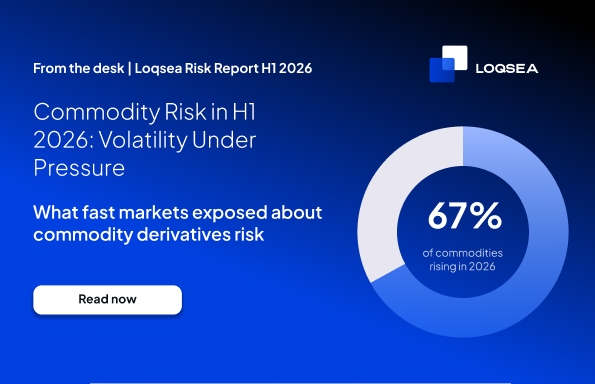
The World Bank Commodity Markets Outlook now forecasts global commodity prices to rise 16% in 2026, the first annual increase since 2022, leaving them approximately 25% higher than anticipated at the start of the year. Within that headline, energy prices are projected to surge 24%, metals and minerals to rise 17%, precious metals to surge 42% to record highs, and agriculture to decline 6%. More than two-thirds of all commodities are expected to record price increases in 2026.
Most CTRM systems were not designed for that. They were designed for a world where each asset class could wait until the overnight reconciliation cycle to be understood. H1 2026 removed that assumption across every commodity subsector simultaneously.
Brent crude moved from $72 to $118 per barrel in a single month, the largest move on record. On the worst sessions of March 2026, a book marked at midnight was a different risk picture at 10am. Every collateral calculation made in that window was made on data that reflected a market that no longer existed.
For desks running end-of-day mark-to-market through their CTRM, VaR became a historical document. It described where risk stood at the close. It did not describe where risk stood now. In a session where Brent moves $15 or gold moves $200, the distance between those two things is not marginal. It is the difference between the book the desk thinks it is managing and the book it is actually running.
More volume across more asset classes in the same session window amplifies every weakness in batch-processed CTRM infrastructure: more positions to reconcile, more margin events to respond to, more cross-commodity exposure that the morning reconciliation will be too late to capture.
Metals moved in four different directions at once. Aluminium hit a four-year high on a direct supply shock. Copper faced competing macro and micro pressures. Tin outperformed the complex on structural scarcity. Lead closed with losses. London Metal Exchange market data. For desks managing cross-venue books across LME and CME, consolidated net exposure was the only number that mattered. For desks that could not produce it in real time, every position-level decision carried an unquantified risk premium.
The infrastructure gap in metals is a CTRM aggregation problem across incompatible position structures. Futures, options, OTC positions, and averaging contracts held in separate modules or systems. Consolidated net exposure across a multi-commodity, multi-venue book is a manual calculation, not a live number. The time it takes to produce that number is time the market does not wait for.
In a session where four metals move in four directions, the difference between a real-time consolidated view and a manual roll-up is the difference between a defensible book and an exposed one.
Precious metals produced a $1,000 per ounce range within six months. Gold peaked above $5,405 per ounce in January, fell nearly 17% to a March low, and found support above $4,400. LBMA Gold Price. On the sessions that drove that range, intraday moves of $200 or more made end-of-day marks meaningless as a risk management tool.
For a gold options desk, delta and Greeks required real-time updates to remain informative. On a day gold moves $200 and Brent gaps $15 in the same session, hedging decisions are made on what is actually happening, not what was happening at midnight. For a directional desk, mark-to-market cadence needs to match the pace of the underlying rather than the pace of the reporting cycle.
The scale of the H1 gold move was the exception. The cadence question it exposed was not. Any period of sustained intraday volatility raises the same question. Whether the CTRM cycle produces information at the pace the market demands, or whether it produces information after the market has already moved on.
Agriculture is projected a 6% price decline overall in 2026 World Bank Commodity Markets Outlook. The operational impact was not price volatility. It was the weight of running a third book through a separate system at exactly the moment energy and metals demanded the most Operations Teams attention. Fragmented infrastructure does not pause for a quieter asset class.
Every hour spent on the agricultural reconciliation was an hour not spent on the exposures that were moving. The book still had to be reconciled. The system that held it still had to be checked. The people who understood it were the same people the desk needed on the energy book on the same morning.
The operational impact of H1 agriculture was measured in the attention it took from the active books, not in its own P&L. That is the specific way in which a quieter subsector participates in a cross-commodity derivatives risk event, and the specific reason why cross-commodity risk is a different operational discipline than single-subsector risk.
H1 2026 made that infrastructure gap expensive. Desks posted defensive margin they could not optimise. Hedging decisions were made on a P&L that reflected midnight, not midday. The first hours of each session were spent reconstructing a position the market had already moved past. The infrastructure was designed for a market that moved at a pace overnight reporting could absorb. H1 2026 was not that market.
The firms that navigated H1 2026 most effectively shared a common operational characteristic. Their risk picture was current when the market was moving. When the risk picture is current, every decision downstream is made from accurate data: hedging decisions, collateral calls, counterparty conversations. When it lags the market by hours, each of those decisions carries an uncertainty premium the desk may not be aware it is paying.
Across commodity derivative desks, the H1 infrastructure gap manifested in three specific, recurring ways. Overnight P&L calculated against the previous session’s closes: on a day energy moves $15 or gold moves $200, a stale P&L is a different risk picture, not an approximation of the current one. Fragmented instrument data across futures, options, OTC positions, and averaging contracts held in separate modules: consolidated net exposure across a multi-commodity, multi-venue book is a manual calculation, not a live number. Defensive margin posting without intraday visibility of margin requirements: across the energy spike of March 2026, that capital cost was measurable and avoidable for desks with the right infrastructure.
Market participants adapting to these conditions are increasingly drawing on real-time CTRM architectures, including AI portfolio interpretation tools that allow front-office users to query the current state of the book directly rather than wait for a reporting cycle to describe it.
Loqsea was built for the front office, in real time, by traders who have managed commodity derivative risk from a desk.
Loqsea Risk Manager holds futures, options, ETD, and OTC averaging positions across every commodity class in a single environment. Trade and pricing data feed in automatically from exchanges and brokers via SFTP, API, and FIX drop copy. Reconciliation runs continuously through the session, and consolidated exposure across the full book is a live number rather than a calculation assembled each morning. Loqsea is an LME Approved Independent Software Vendor and is ranked #25 in the Chartis Research Energy50.
Under the record cross-commodity volumes and correlated volatility described earlier in this article, the operational difference between a generic CTRM system and a real-time architecture becomes measurable across five specific dimensions:
| Under record cross-commodity volume | Generic CTRM | Loqsea Risk Manager |
|---|---|---|
| Consolidated position | Produced last, once every book has reconciled in turn | Available throughout the session |
| Margin across venues | Reconstructed each morning from the previous close | Live against current prices, all venues together |
| Reconciliation breaks | Volume increases, the window to resolve them does not | Surface as they occur |
| Additional asset class | Extends the overnight cycle | The risk picture remains available at the same time |
| Peak load | The cycle lengthens and the lag compounds | Continuous processing, with no queue to clear |
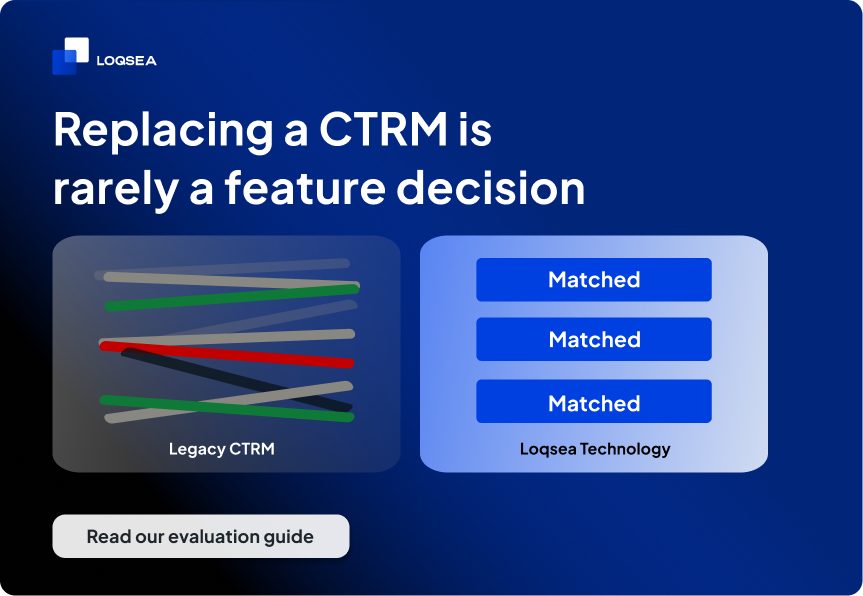
Each dimension in the table corresponds directly to one of the operational frictions H1 2026 exposed. Consolidated position speed determines whether a cross-commodity desk enters the trading session with a current risk picture or with yesterday’s. Margin cadence across venues determines whether collateral decisions are made on live data or on defensive assumptions. Reconciliation break handling determines whether volume increases compound into session-opening backlog. The behaviour when a new asset class is added determines whether cross-commodity growth scales linearly or superlinearly in operational drag. Peak load behaviour determines what the desk actually has visibility on during a March-style stress session.
In a session like March 2026, that is the difference between managing risk and reconstructing it.
Schedule a demo and we will walk you through it in the context of how your desk actually runs.
Real-time risk management means positions, P&L and margin update continuously as trades and prices change through the session. Generic CTRM recalculates at fixed intervals, usually once overnight, so the risk picture a desk works from can sit several hours behind the live market whenever volume is high
An overnight reconciliation cycle is sized around a typical processing load. When one commodity class is busy, the quieter books leave capacity to absorb it and the cycle completes before the open. When every class is busy in the same window, that capacity disappears and the consolidated position becomes the last figure produced.
Yes. CME reported all-time record quarterly average daily volume in Q1 2026, with all six of its asset classes setting records at once for the first time. ICE recorded its highest monthly volume in company history in March 2026, and the London Metal Exchange recorded its strongest quarter to date in the same window.