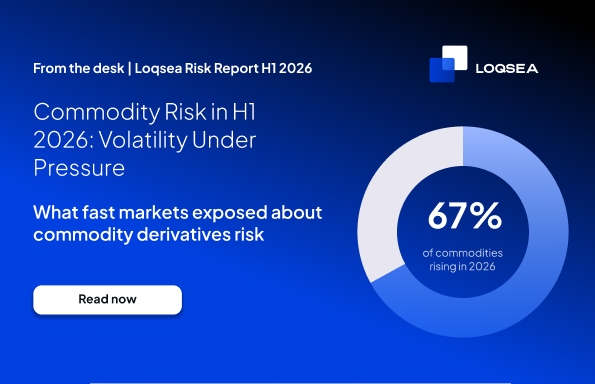
2026 has made the limitations of end-of-day CTRM software unusually visible. Metals and minerals prices are projected to rise 17% this year, with precious metals on course for a 42% surge to record highs. Source: World Bank Commodity Markets Outlook, April 2026. Industrial materials prices rose 10.7% in Q1 2026 alone. Source: S&P Global Commodity Insights, May 2026. For LME derivatives desks, the infrastructure question has moved from background consideration to front-office reality.

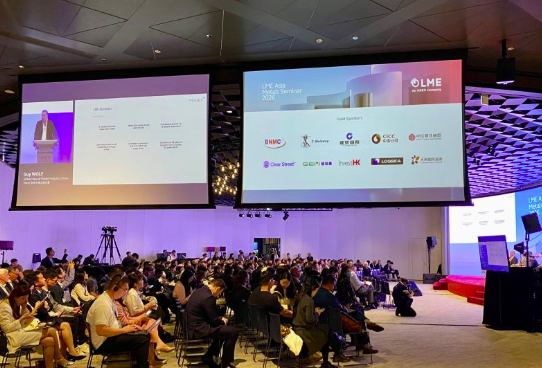
Loqsea Technology is connected to the London Metal Exchange as an ISV, purpose-built for real-time derivatives risk management across LME and OTC positions. We sponsored LME Asia Week 2026 in Hong Kong as a Gold Sponsor.
The trigger was the coordinated US-Israeli strikes on Iran in late February 2026, the largest energy price shock since Russia’s invasion of Ukraine. Brent crude rose from $72 a barrel to $118 within a month, the largest monthly increase on record, as the Strait of Hormuz, carrying roughly 35% of global seaborne crude oil trade, was effectively closed to commercial traffic. Source: World Bank Commodity Markets Outlook, April 2026.
Base metals moved with it. LME average daily volumes reached their highest ever quarter in Q1 2026, up more than 25% year on year, with nickel up 140% and aluminium, copper and lead all reaching new quarterly highs. Source: LME, via Recycling Today, April 2026. Overall commodity prices are forecast to rise 16% in 2026, the first annual increase since 2022. Source: World Bank Commodity Markets Outlook, April 2026.
These are not incremental moves. They are sessions where the gap between a derivatives risk picture updated in real time and one built from last night’s settlement prices stops being an inconvenience and becomes a material gap in what a desk actually knows about its exposure.
Firms running overnight reconciliations and manual processes are a generation behind the exchange they trade on. That was true before 2026, this year has simply made it harder to defer.
When a market moves sharply intraday, a book reconciled at end of day reflects yesterday’s market: the P&L and margin figures on screen are not current, and hedging decisions made on that data are decisions made on an approximation of reality. In normal conditions, that approximation produces friction: a longer reconciliation run, an hour spent reconstructing the book before trading starts. In conditions like Q1 2026, it produces something more consequential.
The LME’s market structure amplifies this problem in ways no other major exchange shares, and it’s a core reason generic CTRM for metals struggles here. Daily prompt dates out to three months, weekly to six, and monthly beyond that out to ten years for some contracts create a date structure that shifts every session. A system that cannot model that structure natively cannot produce an accurate derivatives risk picture at any point during the trading day.
Most CTRM systems were built for generic futures and options markets and handle the LME by approximating its conventions rather than modelling them directly. That approximation is manageable in a low-volatility market. In one where intraday moves that once defined a week now define a session, it carries a cost that accumulates with every position entered and every hedge placed on imprecise data.
The operational consequence was documented in detail by the Financial Conduct Authority’s March 2025 Final Notice on the 2022 nickel crisis, covered in full in a related article below. The conditions that made that crisis so damaging were not unique to nickel: a fast-moving market meeting infrastructure not built for intraday visibility, and 2026 has produced fast-moving markets across the metals complex, not just one contract.
The answer is not faster reporting, but infrastructure that models the LME’s market structure natively, consolidates all derivatives positions into a single environment, and updates continuously throughout the session rather than at a fixed point overnight.
This is where Loqsea Technology was built to operate. As a connected LME ISV, Loqsea has direct connectivity to LME data and clearing infrastructure, so the position, margin, and mark-to-market the desk sees is the same the exchange sees, in real time. Loqsea’s interpolation curve supports real-time valuation across the LME forward curve, an approximation by nature since LME curves are not always linear, but one handled systematically within the platform rather than left to manual processes outside it.
Futures, options, ETD, and OTC averaging positions sit consolidated in a single environment. Risk updates continuously through the session. P&L reflects the current market in real time.
| Generic CTRM for metals | Loqsea Technology | |
| LME connectivity | Requires approximation | Direct, LME Approved ISV |
| Position updates | Overnight reconciliation | Continuous, real time |
| Forward curve valuation | Manual entry or prior close | Native intraday interpolation |
| Instrument coverage | Futures, options, OTC in separate modules | Futures, options, ETD, OTC in one environment |
| Margin visibility | Reconstructed each morning | Live against current prices |
For more on where generic CTRM systems fall short on valuation accuracy for LME participants, see our first blog in this series.
When the next volatile session arrives, will your CTRM software give you an accurate picture of your LME derivatives exposure in real time, or will it give you yesterday’s?