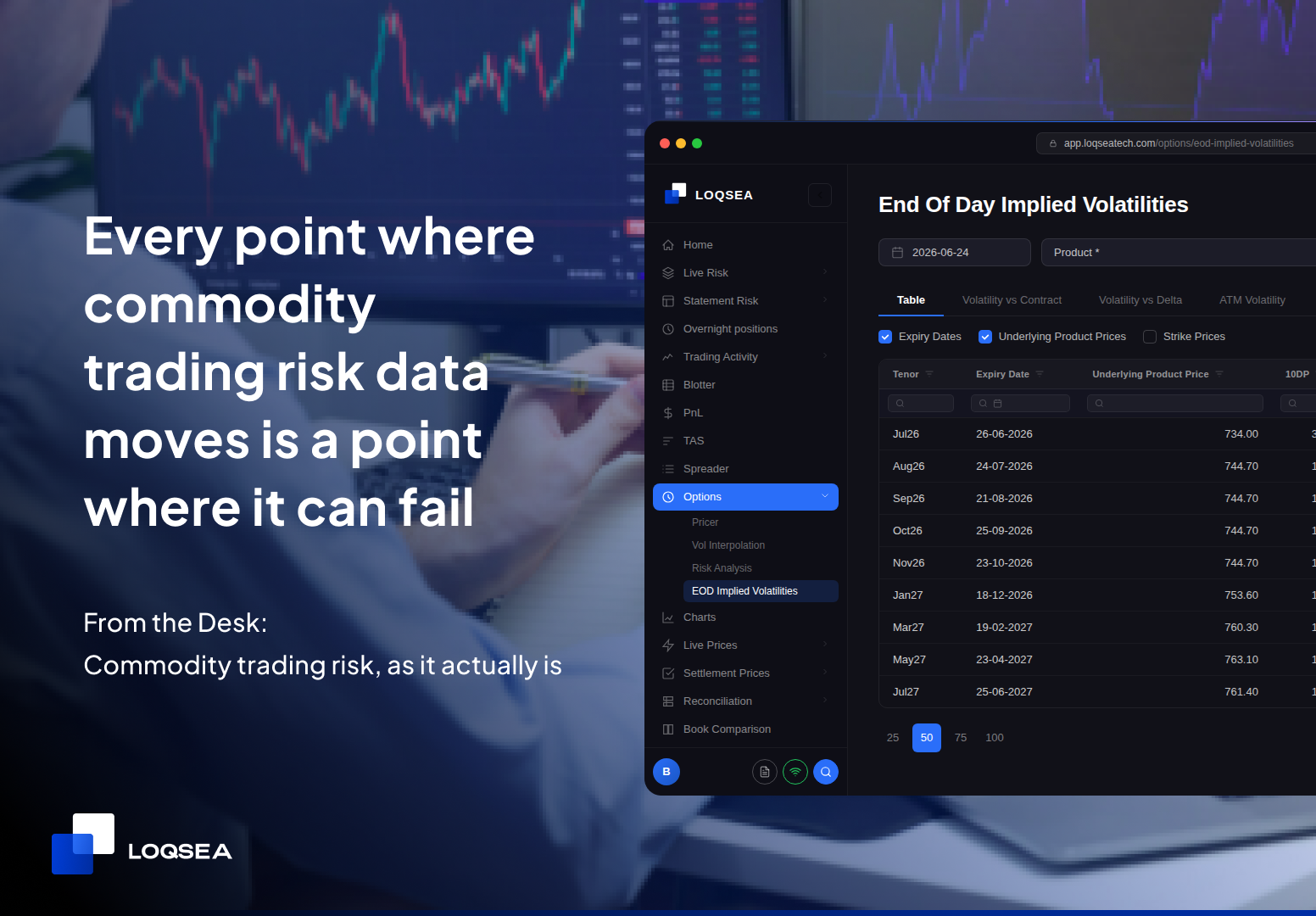
Every point where data moves between systems is a point where it can arrive late, wrong, or both.
This is not a theoretical risk in commodity trading operations. It is the operational baseline for most derivatives desks. When a trade is placed, it is accepted by the exchange, passed to an internal system, and then handed to a risk team to enter manually into a spreadsheet. By the time a risk figure reaches the person responsible for acting on it, the data has already moved through three or four different environments, each transition introducing latency, and each one a potential point of failure.
The problem is not the systems individually. It is the distance between them.
When a trade executes on an exchange, it produces a data event. That event carries position information, price, counterparty, instrument, and timing. In a fragmented infrastructure, that event does not flow directly into a risk calculation. It enters a queue. It waits for the next export cycle. It is formatted, mapped, and ingested by a receiving system that was not built to expect it in real time.
At each stage, the data is a version of what it was at the previous stage. Not a live read. A copy, processed at the moment of transfer and already ageing.
In commodity derivatives, where exposure across instruments and prompt dates can shift materially in minutes, the difference between a live event and a copied version of that event is not a rounding error. It is the distance between knowing your risk position and believing you know it.
Where systems cannot exchange data directly, manual processes fill the gap. An operations team member runs a morning reconciliation. A spreadsheet maps one system’s output to another’s input format. A script runs at the close of each session to synchronise positions.
These processes work until they do not. A script fails silently. A formula references a cell that no longer exists. A reconciliation catches a discrepancy 18 hours after the underlying position moved.
The failure modes are well understood by anyone who has run them. They are not edge cases. They are the expected cost of an infrastructure that was never designed to move data continuously.
Read Loqsea’s article on how fragmented infrastructure undermines commodity trading risk management. From the Desk, content series.
The cost of a fragmented data infrastructure does not sit in one place. It distributes across three teams, each absorbing a different version of the same problem.
| Team | Cost of poor data integration | What changes with Loqsea |
| Operations and middle office | Reconciliation, exception handling, and data mapping absorb capacity that should go to higher-value work. As trade volume grows, that workload grows with it. | No manual import step. Blotter reconciliation runs automatically with mismatch detection, continuously, not at end of day. |
| Technology and infrastructure | Every point-to-point connection between systems requires maintenance, monitoring, and re-testing when vendors update APIs or new instruments are added. Technical debt compounds quietly. | Single data environment. Fewer connections to build, maintain, or diagnose. Adding a new exchange does not require a new integration build. |
| Risk and front office | Decisions made on lagged or assembled data carry exposure that does not appear in any standard metric. In volatile conditions, the gap between what the infrastructure delivered and what the desk actually holds is not visible until it is consequential. | Live position visibility from the moment a trade executes via FIX. The risk picture reflects the present, not the last export cycle. |
Every hour an operations team spends managing data movement is an hour not spent on the work that actually requires human judgement: exception resolution, counterparty management, process improvement. The infrastructure absorbs what the systems cannot.

The integration problem is, at its core, a distance problem. The further data has to travel, the more value it loses in transit. The answer is not faster connections between disconnected systems. It is fewer systems for data to move between.
Loqsea’s Risk Manager addresses this at the point of capture. When a trade executes on any of the major exchanges, like ICE, CME, or the London Metal Exchange (LME), FIX connectivity means that trade event enters the Risk Manager immediately. We subscribe to trade captures and execution reports via FIX. Executions are captured in real time. Processed immediately. Reflected in the live position.
The spreadsheet that bridges two systems disappears when one system can do what previously required two. Blotter reconciliation with automated mismatch detection runs continuously rather than as an end-of-day task. Discrepancies surface in real time, not the following morning.
Operations teams stop absorbing the cost of data movement. Technology teams stop maintaining connections between systems that should not need to exist. Risk and front office work from a position that reflects the present, not the last export.
The integration problem is an infrastructure design problem. It resolves when the infrastructure is built around a single data environment rather than around the connections between separate ones.
Loqsea is a cloud-based commodity trading and risk management (CTRM) platform built for commodity derivatives desks. Automated trade capture, real-time P&L, and blotter reconciliation with mismatch detection, available from day one.
Built by traders who lived the problem. Used by Commodity Trading Advisers (CTAs), hedge funds, and trading desks that cannot afford for data in transit to be the weakest point in their risk operation, book a demo now.
Every time commodity trading risk data moves between systems, it is copied, formatted, and ingested rather than read live. Each transition introduces latency and the possibility of a mapping error the receiving system cannot detect. In commodity derivatives, where positions change continuously across instruments and prompt dates, data that has travelled through multiple environments describes the past rather than the present. The further it has to move, the less it can be relied on.
FIX is a standardised messaging protocol used for real-time trade data exchange between exchanges and trading systems. For commodity derivatives desks, FIX connectivity means executed trades are captured automatically the moment they fill, with no manual import step and no export cycle delay. Exchanges including ICE, CME, COMEX, NYMEX, CBOT, and LME support FIX, eliminating the latency that builds when trade data waits for a batch process.
Manual trade entry and batch imports create two categories of operational risk: latency and error. When trades are captured automatically via direct exchange connectivity, neither exists at the point of capture. The position is recorded as the trade executes. Downstream processes including P&L calculation, VaR, and margin analytics draw from data that is current rather than assembled. Operations teams are freed from the reconciliation burden that manual capture requires.