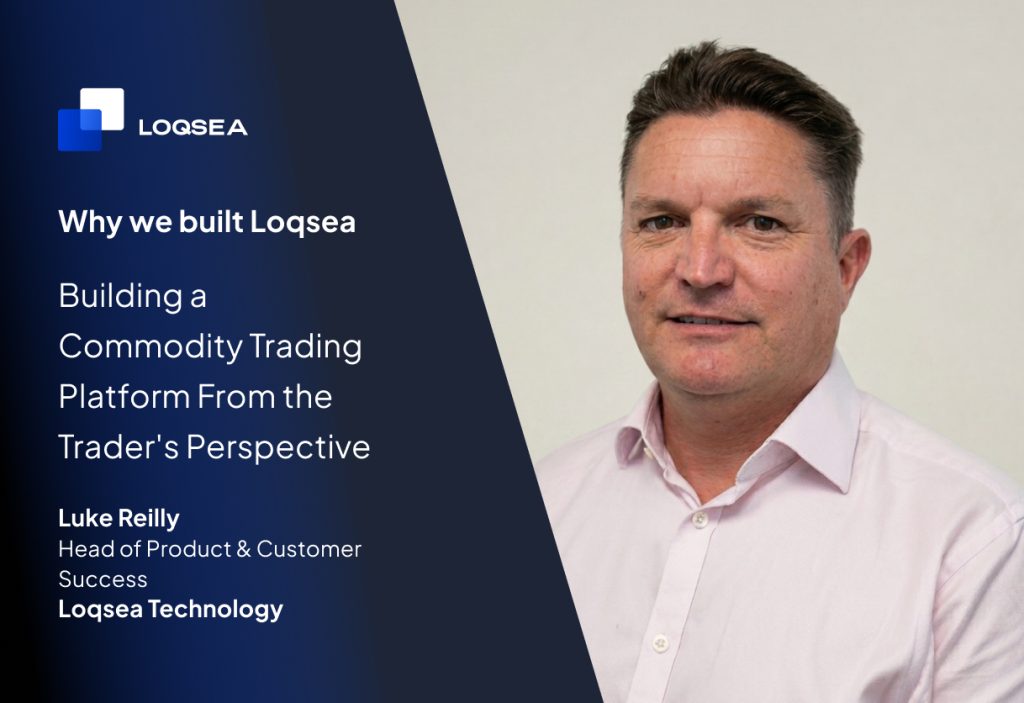
Building a commodity trading platform from the trader’s perspective means the requirements start from how a trader thinks, not from how a database wants to store data. In practice, for Luke, that means live P&L on by default, positions held together, and every build decision traced back to a real problem on a real desk. This is the third article in our Why We Built Loqsea series, and it is about how the platform actually gets built.
Tomasz described the technical gaps he lived with on the desk. Reza explained what existing CTRM platforms were missing. Luke’s role sits between the two: turning a trader’s instinct about what is wrong into a platform that fits the way a desk works, and staying close to it once the desk is live. He came from the desk himself, in commodity derivatives and risk.
“My role is the bridge between the trading desk and the development team. When a trader describes a problem, I get it the way they mean it. I translate that into a requirement, the team builds it, I test it from a trader’s perspective, and once it works we deliver it to the client. That loop is what the platform is built on.”
A platform built from the trader’s perspective is one where the requirements start at the desk. Traders do not think in end-of-day batches. They think in live exposure, right now, across everything they are holding, and the software has to match that.
For Luke, the difference between a platform that fits a desk and one that fights it comes down to where the requirement starts.
“It means requirements start from how a trader thinks, not how a database wants to store things. Traders do not think in end-of-day batches. They think in live exposure, right now, across everything they are holding. So that is how we built it. Positions held together, live P&L on by default. Every one of those decisions came from sitting at that desk.”
That single principle, applied hundreds of times, is what separates a platform designed around a trader’s day from one designed around what was convenient to engineer.
The discipline of leaving things out.
Trading platforms tend to grow crowded, because every prospect and every competitor adds another feature to match. Luke’s test for whether something earns its place is deliberately narrow.
“Simple question: does it remove friction from a trader’s day, or does it just look good on a feature list? I have sat on the wrong side of platforms built to win procurement exercises rather than to be used under pressure. You can tell immediately. If a trader would not miss it, it does not go in.”
The result is a platform where the screen a trader relies on stays uncluttered, and where speed is protected because nothing unnecessary is competing for it.
The clearest signal that something needs building is a workaround a desk has quietly kept alive. A spreadsheet running alongside the platform is not a small inconvenience. It is a live gap, and it usually points directly to the next thing worth building.
Luke gives a recent example.
“A client we onboarded was still running a separate spreadsheet to track their intra-day exposure, which was a key risk metric for them. The platform had everything else they needed, but that one gap meant they were still relying on a manual workaround. We added real-time exposure visibility and the spreadsheet disappeared. That is the kind of feedback that shapes the roadmap.”
That is also why the platform keeps developing: real desks, under real pressure, show exactly where the gaps are.
Most product teams hand software over and move on to the next build. They never watch their software used under pressure, so they are guessing about the things that matter most. Owning both product and customer success closes that gap.
For Luke, staying close to the desk after go-live is the most valuable feedback loop Loqsea has.
“Once a desk is live you find out very quickly what works and what does not. The feedback is immediate and unfiltered. Traders are not shy about telling you when something is not right. That is the part most product teams never get, because they have already moved on to the next build.”
That feedback does not sit in a report. It feeds straight back into what gets built next, which is what stops the platform drifting away from the people it is for.
The fastest way to judge a trading platform is not to sit through a longer demo. It is to ask what the platform does the moment a trader needs it most, before anyone touches a setting.
Luke’s advice to a buyer comes down to three questions.
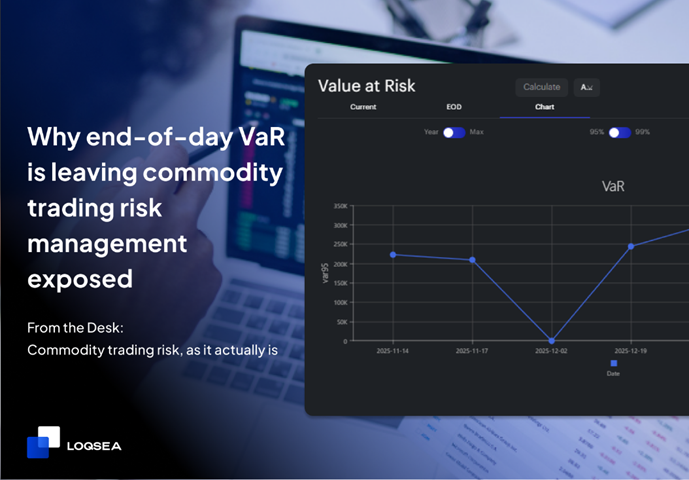
“The questions I would ask are simple. Where is my real-time margin? Where is my intra-day exposure? Where is my VaR? If the answer to any of those involves waiting, exporting, or going somewhere else to find it, it was not built for a trader’s day. It was built around what was convenient to engineer.”
A platform built by people who have sat on a desk answers all three instantly, because the small decisions all went the trader’s way.
The loop Luke describes does not stop at launch. It is also how the platform keeps improving.
“The loop I described at the start, trader instinct in and working software out, is not just how we built Loqsea. It is how we keep improving it. Most platforms are built once and sold many times. We build continuously, because every client that goes live teaches us something new. That is the difference between software that was built for traders and software that was marketed to them.”
Schedule a demo and we will walk you through it in the context of how your desk actually runs.